Updated: 2026-08-20 16:57:30
Daily pocket WiFi rental in Japan looks cheap until you multiply it by ninety days. A rate that feels reasonable for a one-week trip turns into a serious line item once you are staying for a semester, a work assignment, or a full year — and by then you have usually already signed up for it.
Monthly rental is a different product with different economics. It is billed per calendar month rather than per day, it comes with a minimum contract period, and the rate falls as you commit to longer terms. The short version: monthly long-term pocket WiFi in Japan runs from roughly the mid-¥4,000s to the mid-¥6,000s per month, depending on the plan you pick and how long you sign up for.
This guide breaks that down properly — what each plan actually costs across 3, 6 and 12 months, whether unlimited data is worth the premium over a capped plan, what is included in the price, and what can be added to your bill later if you are not careful.
CDJapan Rental offers three monthly plans. Two of them are unlimited and priced identically; the third is capped and cheaper. Here is the full picture.
| Plan | 3-month contract | 6-month contract | 12-month contract |
|---|---|---|---|
| WiMAX+5G Unlimited | ¥6,600/month | ¥6,000/month | ¥5,500/month |
| SoftBank Unlimited | ¥6,600/month | ¥6,000/month | ¥5,500/month |
| SoftBank 100GB/month | ¥5,900/month | ¥5,300/month | ¥4,600/month |
All rates in Japanese yen, tax included, as of the date shown at the top of this article. Approximate figures in other currencies would depend on the exchange rate on the day you order, so we quote yen only — that is what your card will actually be charged.
Two things stand out immediately. First, the gap between the shortest and longest contract is meaningful — roughly a thousand yen a month on the unlimited plans and more than that on the capped one. Second, the two unlimited plans cost exactly the same. That second point matters more than it looks, and we come back to it below.
The monthly rate drops as the commitment lengthens for the same reason it does with most rental equipment. A device that goes out once and stays out for a year involves one round of shipping, one setup, one return, and one inspection. A device that turns over every three months involves four of each. Those handling costs are spread across the months you keep it, so the longer you keep it, the thinner they spread.
The trade-off is the minimum contract period. A 12-month rate comes with a 12-month minimum, and leaving before that period ends means paying a cancellation fee. So the cheapest headline rate is not automatically the cheapest outcome — it is only cheaper if you actually stay for the full term. We work through that arithmetic near the end of this article.
This is the question most people are actually asking when they look up pricing, so let us put a number on it.
Unlimited costs roughly ¥700 to ¥900 more per month than the 100GB plan. Over three months that is about two thousand yen. Over six months, a little over four thousand. Over a full year, close to eleven thousand.
Those are real amounts but they are not enormous, which means the decision should turn on whether 100GB is genuinely enough for you rather than on the price gap alone.
One hundred gigabytes across a thirty-day month works out to a little over three gigabytes a day. That is more generous than it sounds. Browsing, messaging, maps, music streaming, social media, email and a couple of hours of standard-definition video a day will sit comfortably inside it. Most people who use their connection the way they used it back home, on a phone and a laptop, will not come close to the ceiling.
Where it runs out is at the higher end of the usage curve:
Exceeding the cap on the 100GB plan does not disconnect you and does not trigger an overage charge. Speed is reduced to 256kbps for the remainder of the billing month. In practice that is enough for text messaging and basic email, and not enough for much else — video will not play reliably, maps will be slow to load, and web pages will feel broken. It resets at the start of the next month.
The short answer: if you are a single user browsing, messaging and streaming at normal quality, the 100GB plan is the better value and you will probably never notice the cap. If you work online, share the connection with someone else, or watch a lot of high-resolution video, take unlimited — the premium is small compared with spending the last week of every month throttled.
Ready to compare the plans side by side? All three monthly options are on the long-term pocket WiFi page.
Because the two unlimited plans are priced identically, choosing between them is not a budget decision at all. It is purely a question of which hardware and network suits your situation. This is worth understanding properly, because it is the one comparison a price-aggregation site cannot make for you.
| WiMAX+5G Unlimited | SoftBank Unlimited | SoftBank 100GB | |
|---|---|---|---|
| Network | 5G (Sub6/NR), 4G LTE, WiMAX2+ | 4G LTE | 4G LTE |
| Maximum speeds | 2.7Gbps down / 183Mbps up | 150Mbps down / 50Mbps up | 150Mbps down / 50Mbps up |
| Simultaneous devices | Up to 16 | Up to 5 | Up to 5 |
| Data | Unlimited | Unlimited | 100GB, then 256kbps |
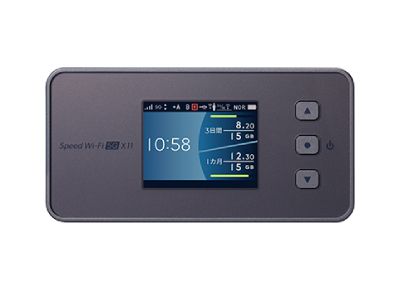
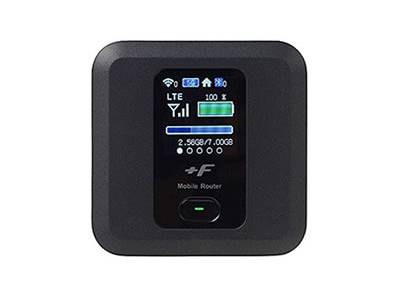
| Device weight | 174g | 128g | 128g |
Those maximum speeds are theoretical ceilings under ideal conditions, as they are with every mobile service anywhere. Nobody sees 2.7Gbps in daily use. What the specification does tell you reliably is the relative headroom between the two devices, and the upload figure in particular is a genuine practical difference.
WiMAX+5G suits you if you will be based in or around a major metropolitan area, you need to connect several devices at once, or your work involves pushing data upward — video calls, file uploads, cloud backups. The higher device limit also makes it the sensible choice if you are sharing with a partner or housemates.
SoftBank suits you if you expect to spend time in regional cities and smaller towns, you are connecting only a couple of devices, or you would rather carry the lighter unit. SoftBank's LTE footprint is broad and consistent across the country.
One caveat on 5G: coverage in Japan is still expanding and is not nationwide. It is strongest in dense urban areas and patchier in rural and mountainous regions, and signal inside large buildings can be unstable regardless of which network you are on. If a specific destination matters to you, check coverage for that area before deciding. Outside 5G zones the WiMAX device falls back to 4G LTE and keeps working.
The monthly rate is not a base rate with extras layered on top. It covers the device and everything needed to use and return it:
There is no separate activation fee, no SIM issuance fee, and no charge for the return postage. There are, however, four things that can add to your bill, and they are worth knowing about before rather than after:
All of these are billed to the card you used at order time, so keep that card valid for the duration of your contract.
Monthly rates are useful for comparison but nobody budgets in monthly rates — you budget for the whole stay. Here is what each plan comes to in total.
| Length of stay | Unlimited (either plan) | SoftBank 100GB | Difference |
|---|---|---|---|
| 3 months | ¥19,800 | ¥17,700 | ¥2,100 |
| 6 months | ¥36,000 | ¥31,800 | ¥4,200 |
| 12 months | ¥66,000 | ¥55,200 | ¥10,800 |
One billing detail affects these totals: monthly fees are charged around the first of each calendar month, and the month in which you place your order is billed as a full month regardless of the date you order. A discount is applied to that first month — the exact amount shows on the order page — but the practical implication still holds. Ordering early in a calendar month gets you more days for the same first-month charge than ordering near the end of one.
Monthly pocket WiFi aimed at foreign residents in Japan is a small market with a handful of providers, and the headline monthly rates across it are closer together than you might expect. What actually separates them is structural, and it is worth understanding before you compare two numbers side by side.
Is there a minimum contract period, and does the rate fall with length? These two go together. Providers that offer no minimum commitment generally charge one flat monthly rate no matter how long you stay. Providers that ask for a minimum term — as we do — reduce the rate as the term lengthens. Neither is better in the abstract. Flat, no-commitment pricing wins on short and uncertain stays; tiered pricing wins once you are committing to six months or a year.
Is "unlimited" actually uncapped, or is it a large allowance? A number of long-stay plans marketed for heavy users are 100GB or 200GB caps rather than genuinely uncapped service. That is a meaningful difference if you work online or share the connection, and it is not always obvious from the plan name.
What is added at checkout? Setup fees, mandatory or optional insurance charged monthly, and delivery charges vary considerably between providers. A rate that looks lower on the plan page can end up higher on the invoice.
On the longer terms, particularly twelve months, our rates sit at the low end of what is available. On a three-month term the gap narrows, and a flat-rate provider with no minimum commitment may come out similar or slightly cheaper — you are paying a small premium for the tiered structure that only pays back over a longer stay.
The genuinely uncapped plans are where we tend to be furthest ahead, because the closest comparisons elsewhere are usually large allowances rather than truly unlimited service, and they are priced above our unlimited tier. The other differentiator worth knowing is 5G: most rental routers aimed at foreign residents in Japan are 4G LTE only, and WiMAX+5G is one of the few 5G-capable options in this segment.
This is the honest answer for anyone whose plans are still fluid, and it points to a different product of ours rather than a different provider.
Alongside the monthly plans, we run short-term pocket WiFi rental for stays of under 90 days, billed by the day with the same three plan options. It has no minimum contract period and no cancellation fee — orders cancelled five or more days before the start date are refunded in full — and you can extend it at any time from My Page before the return date. Shipping is a flat ¥690 per order and return is free from anywhere in Japan.
The per-day rate is naturally higher than a monthly plan works out to, so the trade-off is straightforward:
If you start on daily rental and it becomes clear you are staying much longer, switching to a monthly plan is straightforward — get in touch and we will sort it out.
Pocket WiFi is not the only way to get online for a few months in Japan, and it is not automatically the cheapest. What it is, reliably, is the option with the fewest preconditions.
Per-day pricing on a short travel data plan is low, and for a trip of a week or two it is unbeatable. The problem for longer stays is structural: these products are typically built around validity windows of thirty days or less, so covering several months means buying and installing a new one repeatedly. The accumulated cost climbs, and each renewal is another task on a list that is already long. An eSIM also serves one phone. If you are also working on a laptop or a tablet, you are either tethering constantly or buying data twice. For short stays, or as a backup connection alongside a router, a Japan eSIM is an excellent choice — for a multi-month primary connection it is usually the more expensive route.
Headline monthly rates from Japanese carriers and budget operators can undercut pocket WiFi. The obstacle is eligibility rather than price. A standard contract generally requires a residence card showing your registered Japanese address, and usually a Japanese bank account or a domestically issued card for payment. Getting those takes time after arrival — municipal registration, then the card, then the bank — and contracts frequently come with multi-year commitments and their own cancellation penalties. We cover this in more detail in our guide to getting internet without a Japanese bank account.
For a genuinely long stay in fixed accommodation, home fibre is the best connection you can get and the monthly cost is competitive. It also involves an installation fee, physical work in the building, a wait that commonly runs to several weeks, landlord permission, and a contract you then have to cancel when you leave. Monthly apartments, share houses and hotels usually will not permit installation at all. For anything under a year it rarely pays back.
Set against those three, the monthly rate on a rented router is not really a data charge. It is the price of not needing a residence card, not needing a Japanese bank account, not waiting for an installation appointment, and being able to leave with a few weeks' notice. If your circumstances mean the alternatives are simply closed to you, that is the whole value proposition. If they are open, the comparison is closer and worth doing on your own numbers.
Four things make a measurable difference to what you actually pay.
Match the contract length to your real end date, not your hoped-for one. The temptation is to take the 12-month rate because the monthly number is lowest. But leaving early inside the minimum period costs a month's fee on top of what you have already paid, which can wipe out the saving. If your departure date is fixed and documented — a programme end date, a contract end, a return flight already booked — take the longer term and the lower rate. If it is provisional, take the shorter contract and continue month to month once the minimum has passed. The rate is slightly higher, and you keep the option to leave.
Know the cancellation deadline. Cancellation requests are processed against a cut-off of 15:00 on the 20th of each month, Japan time. Submit before it and your contract ends at the end of that month, with no charge on the first of the next. Submit after it and you are billed for one more month. Missing this by a day is the single most common way people pay for a month they did not use.
Cancel formally — returning the device is not enough. The subscription continues until a cancellation request is submitted through My Page. Posting the router back without doing that does not stop the billing. The cancellation procedure is here.
Return on time and order in good time. Late fees accrue daily and the loss charge is substantial. At the other end, orders need to be placed at least three days before your rental start date, and a week ahead is safer for stock — booking early also removes any need to pay for express shipping.
Among CDJapan Rental's monthly plans, the SoftBank 100GB plan on a 12-month contract has the lowest monthly rate. The cheapest plan for your situation, though, depends on how long you are staying — a low monthly rate on a long contract stops being cheap if you leave before the minimum period ends.
The monthly plans start at a three-month minimum contract. For stays of a month or less, short-term daily rental is the right product.
No. Payment is by credit or debit card, and cards issued outside Japan are accepted — you only need to confirm your card is enabled for overseas online payments. No Japanese bank account and no proof of Japanese address are required.
The unlimited plans have no monthly data cap. The network operator's policy allows for speed restriction during peak hours if an extremely large volume is used within a short window, which is standard across the industry. Based on our review of usage data between January 2024 and January 2025, no customer on these plans was restricted despite heavy use.
Cancelling inside the minimum contract period costs one month's fee. After the minimum period has passed there is no cancellation fee, but you must still submit a cancellation request — the subscription does not stop on its own.
Yes. Delivery within Japan and a prepaid return envelope are both included. Optional express shipping is the only delivery-related charge, and only if you request it.
For most people staying three months or more, the decision comes down to two questions asked in order. Will 100GB a month cover how you actually use the internet? If yes, the capped plan saves you a few thousand yen over the stay and you will not notice the difference. If no, unlimited costs a few hundred yen a month more and removes the problem entirely. Then, separately: do you need the 5G headroom, the upload speed and the higher device limit of the WiMAX router, or is the lighter SoftBank unit with its broad LTE footprint the better fit? Since both unlimited plans cost the same, that second question costs you nothing to answer honestly.
Sort out your internet before you land.
CDJapan Rental's monthly pocket WiFi plans need nothing but a credit card — no residence card, no Japanese bank account, no installation. Order online, collect at an airport post office or have it delivered to your hotel or address in Japan, and drop it in a postbox when you leave.
For use over 90 days (Monthly Plan)