Updated: 2026-08-20 17:10:39
The moment the visa comes through, the list starts: book the flight, sort the first month's accommodation, get insurance, organise money, tell work you are leaving, update the CV. Internet usually lands somewhere near the bottom of that list, filed under "figure it out when I get there."
Which is a problem, because it is the one thing on the list you need on day one — to find the train, to message your accommodation, to tell people at home you landed. And for the first several weeks after that, you need it constantly: apartment hunting, job applications, working out which ward office you are registered to, translating documents you cannot read. All during the exact window when you are not yet able to sign a Japanese phone contract.
This guide covers the full year: why the first month or two is the hard part, how to handle moving between cities and seasons, what a year of internet actually costs, and what happens if you head home early.
A note on the programme. Japan's working holiday scheme runs on bilateral agreements. Among English-speaking countries, Australia, New Zealand, Canada, the United Kingdom and Ireland are all partner countries — the United States is not. Age limits, quotas, funds requirements and whether you can apply more than once vary by country and do change over time. Check the Japanese embassy or consulate in your own country for the current rules; nothing in this article should be treated as visa advice.
Arrange a long-term pocket WiFi rental before you fly, collect it on arrival, and keep it for the year. It needs nothing but a credit card — no residence card, no Japanese address, no local bank account — so it works from the day you land, which none of the alternatives do.
If you are certain you are staying the full twelve months, the 12-month contract carries the lowest monthly rate. If your plans are loose, or you intend to switch to a Japanese carrier once your paperwork is sorted, take the 3-month contract and continue month to month after the minimum period.
The rest of this article explains why, and where you might want to do something different.
Most guides to getting online in Japan are written for tourists or for exchange students. A working holiday sits awkwardly between the two, and the differences matter.
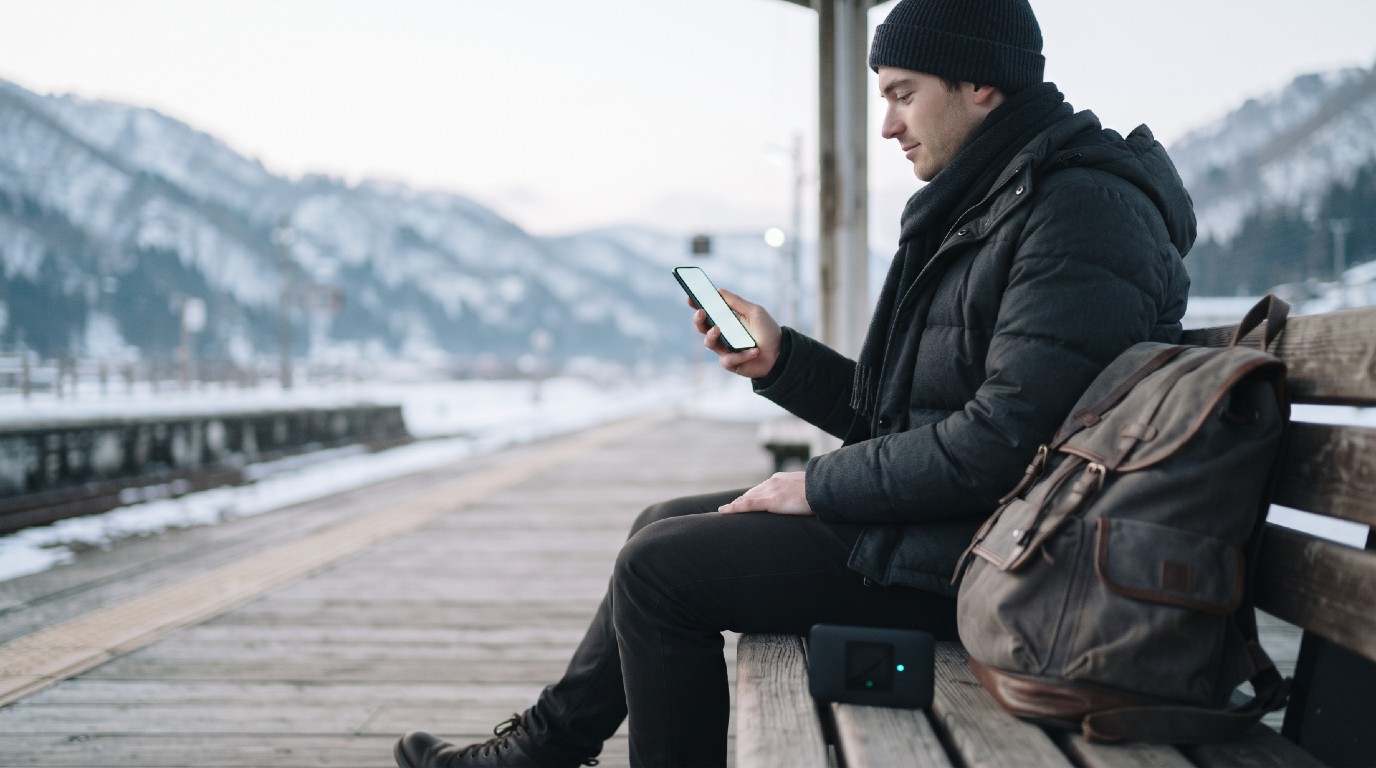
An exchange student usually spends the year in one city, in one dormitory. A working holiday tends to look more like this: a few months in Tokyo or Osaka to find your feet, a winter season in Niseko or Hakuba, then somewhere warmer when the snow goes. Jobs change from hospitality to a guesthouse to a farm; accommodation changes with them.
Anything tied to a registered address has to be re-registered every time you move. A pocket WiFi router goes in your bag. No address change, no new contract, no reconnection appointment, and you do not even have to re-enter a password on your devices.
Students have an international office. Company transferees have an HR department. On a working holiday you do all of it yourself — residence registration, national health insurance, opening a bank account, finding a flat, signing a lease — in a language you are probably still learning. That means your setup period is typically longer than other people's, and it means you need a connection to research your way through it.
The working holiday visa generally allows a stay of up to twelve months. That happens to line up exactly with the longest and cheapest monthly rental term, so if you know you are staying the full year, you can access the lowest rate available. It is one of the few practical advantages of this visa category.
You are earning in yen and spending in yen, and for the first month or two you are spending before you are earning. Fixed costs get scrutinised. But internet is the one you cannot really cut — shifts get organised over LINE, flats get found online, wages get transferred home through a banking app, and family video calls are the thing that gets you through February.
This is the section that matters most, because it is where things actually go wrong.
Signing a standard mobile contract with a Japanese carrier generally requires a residence card showing your registered Japanese address, and most providers also want a Japanese bank account or a domestically issued card. Getting there looks roughly like this:
A month or two if it goes smoothly. Longer if it does not. And note step two: finding somewhere to live is itself something you need internet for. It is a circular problem, and we have a separate article on breaking that loop.
One thing: a credit or debit card enabled for overseas online payments.
And because none of those are required, you can book it before you leave home. Have it sent to an airport post office or to your first night's accommodation, switch it on when you land, and spend day one navigating with maps and messaging a landlord through a translation app instead of hunting for café WiFi.
Want to see what is available? All three monthly plans and their rates are on the long-term pocket WiFi page.
| Option | Residence card needed? | Japanese bank account? | Commitment | When you move | Best for |
|---|---|---|---|---|---|
| Long-term pocket WiFi | No | No | 3, 6 or 12 months | Take it with you | The whole year, and essential for the first part |
| Japanese carrier contract | Yes | Usually | Often long | Address change required | Later on, if you settle in one place |
| Budget MVNO plan | Yes | Usually | Varies | Address change required | Light users who only need a phone |
| Travel SIM or eSIM, repurchased | No | No | None | Unaffected | Stays under a month, or as a backup |
| Home fibre | Yes | Usually | Long contract | Cancel and reinstall | People staying put for years |
Two of those deserve a word of explanation.
Travel eSIMs are built around validity windows of thirty days or less. Covering a year means buying and installing one a dozen or more times, and the accumulated cost usually exceeds a monthly plan. They are excellent as a backup, though — if your router runs flat on a travel day or has to go in for a swap, having a Japan eSIM already installed on your phone means you are never fully offline.
Home fibre is effectively out of reach. Beyond the residence card and the long lease, there is an installation fee, physical work in the building, a wait of several weeks, and a cancellation process at the end. Share houses, staff accommodation and monthly apartments almost never permit installation anyway. Over twelve months it does not pay back.
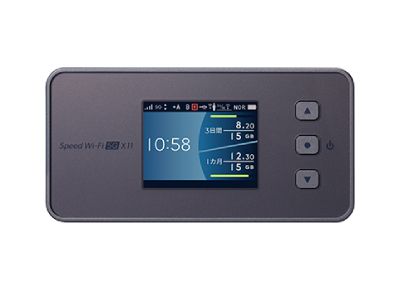
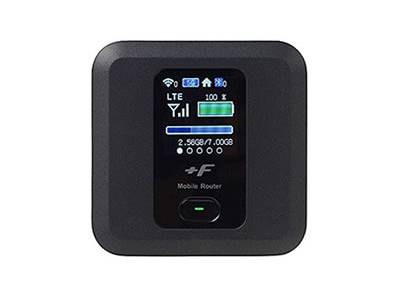
CDJapan Rental offers three monthly options: WiMAX+5G Unlimited, SoftBank Unlimited, and SoftBank 100GB per month. Full rates for every term, plus the maths on whether unlimited is worth the premium, are in our pricing breakdown.
The important thing to know is that the two unlimited plans cost exactly the same, so choosing between them is purely about the hardware and the network — it costs you nothing to pick the right one.
This is the single most relevant point for Australian and New Zealand readers, since a large share of working holidays start with a winter season.
Ski resort towns — Niseko, Hakuba, Nozawa Onsen, Furano — are not metropolitan areas. 5G coverage in Japan is not nationwide, and rural and mountainous regions are still predominantly 4G LTE. Signal inside large buildings and under heavy tree cover can also be unstable regardless of provider.
In practice this means the 5G advantage of the WiMAX device is largely irrelevant if you are spending the season in the mountains, and the SoftBank unit's broad, even LTE footprint is often the more sensible pick. It is also lighter, which you will appreciate if it lives in a jacket pocket on a chairlift. If you have a specific resort in mind, it is worth checking coverage for that area before you decide.
For Tokyo, Osaka, Nagoya, Fukuoka and the surrounding areas, WiMAX+5G is the better device. It has 5G access where the network reaches, meaningfully higher upload speeds, and supports up to sixteen simultaneous connections against SoftBank's five. That device limit matters more than people expect once you are sharing a share house.
Splitting the cost with housemates is common and works well, but two things follow from it. Take WiMAX+5G for the higher connection limit, and take an unlimited plan rather than the capped one — a data allowance that is generous for one person disappears quickly across three or four.
A pocket WiFi rental is not tied to an address. Moving from Tokyo to Sapporo means putting the router in your bag. There is no address change to file, no contract to amend, and nobody to notify. A carrier contract or a fibre connection would require paperwork at both ends, and fibre would need cancelling and reinstalling entirely.
Every new place you stay, the network name and password are the same ones your devices already know. No asking a manager for the guesthouse WiFi password, no discovering that the staff accommodation connection is shared between fifteen people, and no gap on moving day while something gets connected.
Farm work, island guesthouses, onsen towns and mountain lodges all sit outside the areas where mobile coverage is densest. This is true of every provider in Japan, not just one. If you already know where you are heading, check that area's coverage before choosing a device — and as a general rule, the further from the big cities you expect to be, the more the SoftBank option makes sense.
Both are extremely common on a working holiday, and both are situations where a portable router does well.
The caveat is the same as always: shared bandwidth is divided bandwidth. If three or four of you are splitting one router, take the unlimited plan.
This comes up on a working holiday in a way it does not for most travellers: job applications usually ask for a Japanese contact number.
To be clear about what a rental router is and is not — it provides data only. There is no phone number and it cannot send or receive SMS. That is the nature of the product rather than a shortcoming.
What most people do is use the router for data and handle communication through LINE, which is close to universal in Japanese casual workplaces, then arrange a Japanese number separately once the residence card and bank account are sorted. Requirements, documents and the common pitfalls are covered in our guide to getting a Japanese phone number.
One related tip worth acting on before you fly: if any of your banking or payment apps use SMS for two-factor authentication, check whether you will actually receive those messages abroad, and switch to app-based or email verification where you can.
Honestly: if you are staying the full year and settling in one city, moving to a Japanese carrier once your paperwork is done can work out cheaper over the remaining months. We are not going to pretend a rental router is the best answer at every stage.
Three things to weigh before you do it:
The safer pattern, if you think you might switch, is to take the 3-month rental contract and continue month to month once the minimum has passed. The rate is a little higher than a 12-month term, and in exchange you can walk away whenever the new connection is up and running.
It happens more than people admit — a job falls through, something happens at home, or you simply decide a year was ambitious. Three things to know.
It is charged to the card you used at order time. This is precisely why a loose departure date argues for the shorter contract rather than the cheapest monthly rate.
Cancellation requests are assessed against 15:00 on the 20th of each month, Japan time:
For example: request cancellation on 19 April and the contract ends on 30 April with no charge on 1 May. Request it on 21 April and the contract runs to 31 May, with a charge on 1 May. Two days apart, one month's difference.
This is the mistake people make. The subscription continues until a cancellation request is submitted through My Page. Returning the device without doing that does not stop the billing. Submit the cancellation here before you fly.
For the return itself, put the router and accessories in the prepaid envelope supplied and drop it in any postbox in Japan by the end of your rental period. Late returns are charged at ¥1,200 per day, and anything not received within five days of the end date is treated as lost at ¥24,000 per device.
No. A long-term pocket WiFi rental needs only a credit or debit card enabled for overseas online payments. No residence card, no proof of Japanese address, no Japanese bank account and no Japanese phone number are required, so you can book before you leave home.
If you are confident you are staying the full twelve months, the 12-month contract has the lowest monthly rate. If your plans are provisional, or you intend to switch to a Japanese carrier partway through, take the 3-month contract and continue month to month once the minimum period has passed.
Nothing. A pocket WiFi rental is not tied to an address, so moving city or changing accommodation just means taking the router with you. There is no address change to register and nobody to notify.
Mobile coverage in mountain and rural areas is less dense than in cities, and 5G in particular is not available nationwide — these regions are predominantly 4G LTE. This applies to all providers. If you are spending a season in a resort town, the SoftBank plan with its broad LTE footprint is generally the safer choice, and it is worth checking coverage for your specific location beforehand.
Yes. Nothing is installed, so no landlord or manager approval is needed. You can also share it with housemates — up to sixteen devices on WiMAX+5G and up to five on SoftBank — though for shared use an unlimited plan is strongly recommended over the capped one.
No. A pocket WiFi rental provides data only, with no phone number and no SMS. Most people use LINE for work communication in the early months and arrange a Japanese number separately once their residence card and bank account are in place.
You must submit a cancellation request through My Page — simply posting the router back does not stop the billing. Requests are assessed against 15:00 on the 20th of each month, Japan time: submit before it and the contract ends that month, submit after and it runs to the end of the following month. Cancelling inside the minimum contract period costs one month's fee.
The hardest part of a working holiday is rarely the work. It is those first few weeks when nothing is sorted — no flat, no paperwork, no job, limited Japanese, and every small task requiring three things you have not looked up yet.
Internet does not solve any of that. But without it, none of it moves at all. And it is the one item on the whole list you can settle before you go, in about ten minutes, for the price of a few coffees a month.
Sort out your year of internet before you fly.
CDJapan Rental's long-term pocket WiFi needs only a credit card — no residence card, no Japanese bank account, no installation. Choose a 3, 6 or 12-month contract, take it with you when you move cities or chase the snow, and post it back in any postbox when you head home.
For use over 90 days (Monthly Plan)