Updated: 2026-09-08 18:11:12
"Home WiFi" and "Pocket WiFi" sound remarkably similar. Since both allow you to get online wirelessly without drilling holes in your walls, it’s completely understandable why so many newcomers to Japan get them confused.
You might find yourself asking: "If I get Home WiFi, am I stuck using it inside my apartment?" or "Is a Pocket WiFi unit really strong enough to handle all my home internet needs?" These are some of the most common questions expats and travelers ask.
In this guide, we'll break down how these two options work, compare their costs and technical specs side-by-side, and explain why a single flexible device is often the smartest choice for long-term stays in Japan.
Internet setups in Japan generally fall into three main categories: Fiber Optic (Hikari) Broadband, Home WiFi, and Pocket WiFi.
Fiber optic internet requires a technician to physically wire your apartment—a process that involves strict landlord permissions, long waiting times, and installation fees. On the flip side, both Home WiFi and Pocket WiFi connect to Japan's major cellular networks (such as NTT docomo, au, SoftBank, and Rakuten Mobile). Because both offer instant "no-installation" connectivity, people frequently mix them up.
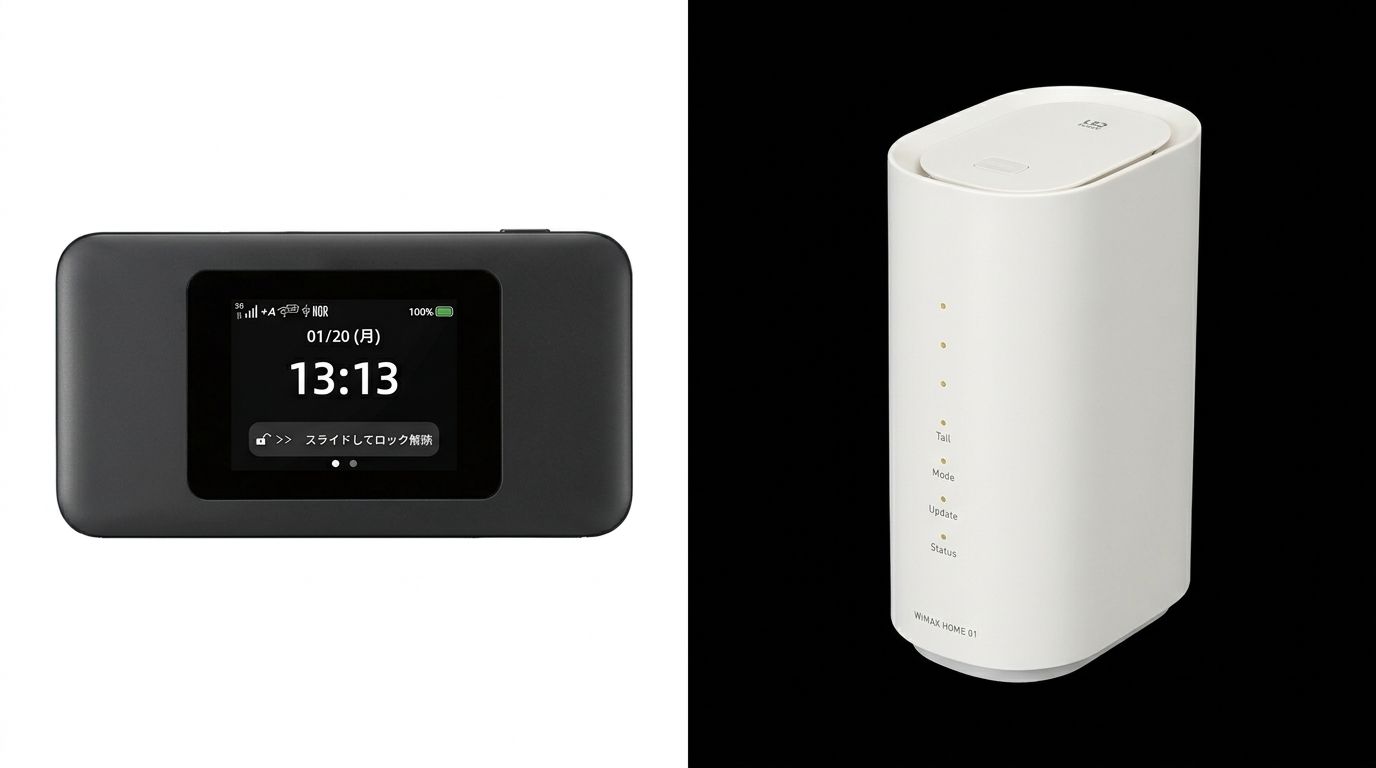
Home WiFi consists of a home router unit (often called a "home block" or "plug-in router") that plugs directly into a standard electrical outlet. It skips the hassle of fiber installation and scheduling technicians—you simply plug it in, and your home is online immediately. It’s a solid choice if you plan to stay at one address for a long time and have zero need for mobile internet on the go.
True to its name, Home WiFi is engineered strictly for stationary home use. If you move apartments, you must go through an official address change process. More importantly, these devices are not meant to be taken out of the house. In fact, many Japanese service providers lock the connection so it only functions within the immediate vicinity of your registered home address.
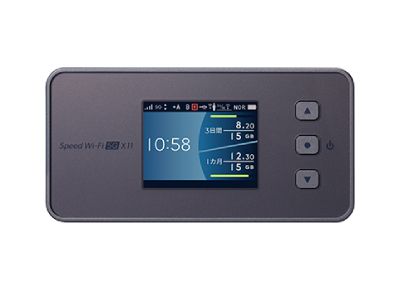
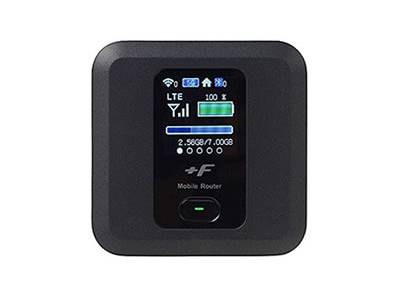
Pocket WiFi (also known as a mobile hotspot or portable WiFi) is a compact, battery-powered router. You can use it at home, bring it to coffee shops, or stay connected while riding the Shinkansen or subway. While it allows multiple devices to connect simultaneously just like a home router, its portability makes it ideal for digital nomads, students, travelers, or anyone whose living arrangements might change.
Because it relies on an internal battery, you’ll need to recharge it regularly. Additionally, depending on the model, portable units may have slightly smaller coverage antennas or support fewer simultaneous connections compared to heavy-duty home routers.
(Note: Certain models, such as select SoftBank Wi-Fi devices, can actually be used continuously while plugged in, even with the battery removed.)
| WiFi Type | Setup Time | Portability | Ideal User |
|---|---|---|---|
| Fiber Optic (Hikari) | 2 weeks to 1 month | None (Fixed) | Long-term residents settled in one permanent location. |
| Home WiFi | Same day / Next day | None (Stationary) | People who only need home internet and won't be moving soon. |
| Pocket WiFi | Same day / Next day | 100% Portable | Anyone who needs internet on the go or expects to move. |
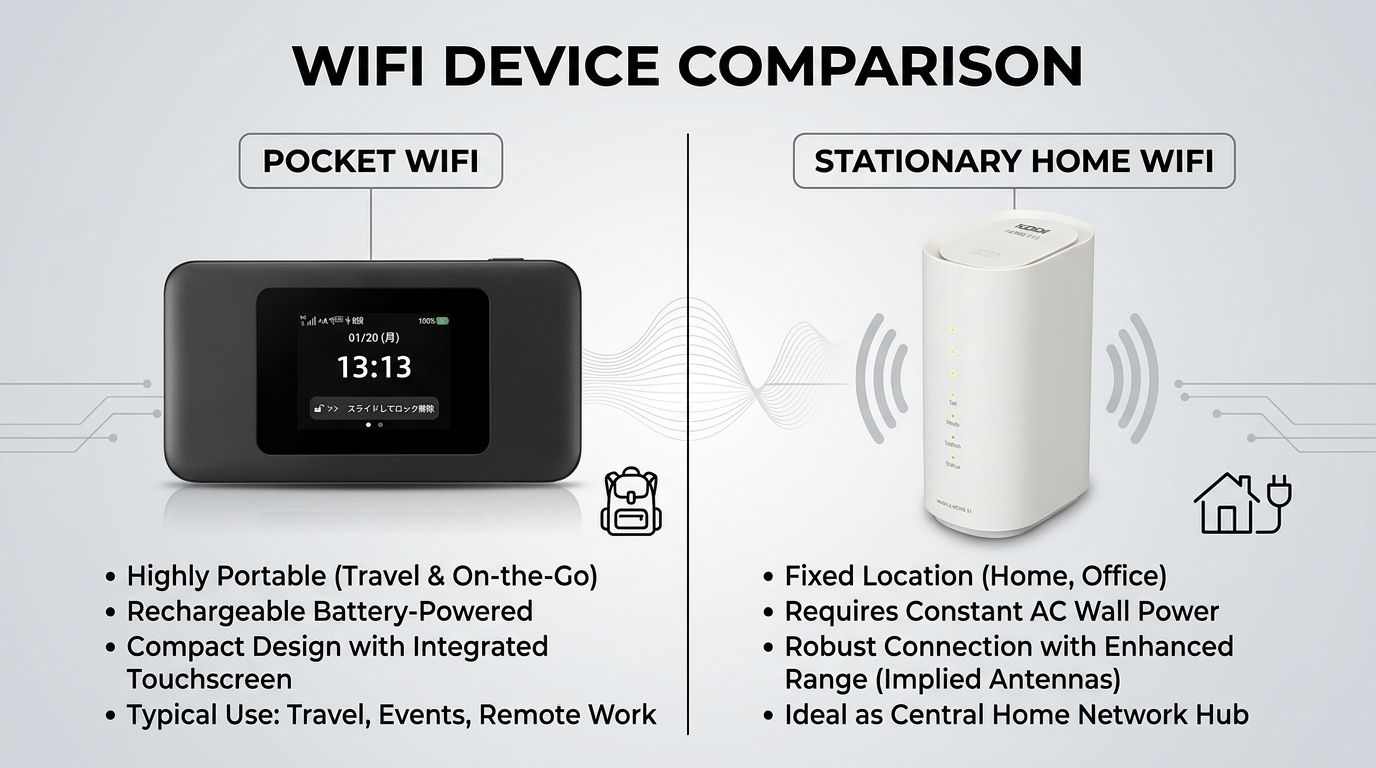
The distinction between Home WiFi and Pocket WiFi goes beyond physical portability—their internal hardware specs are tailored for very different workloads. One crucial factor that buyers often overlook is the maximum number of connected devices.
| Feature | Home WiFi | Pocket WiFi |
|---|---|---|
| Simultaneous Devices | 20 to 30+ devices (model dependent) | 5 to 16 devices (model dependent) |
| Power Source | Continuous AC wall outlet power | Internal rechargeable battery |
| Battery Life | N/A (Always plugged in) | Approx. 8 to 20 hours |
| Size & Weight | Larger, heavier home unit | Compact, lightweight (pocket-sized) |
| Primary Use Case | Families, shared houses, smart home setups | Personal use, remote work, travel, small groups |
Because Home WiFi routers run on continuous AC power, you never have to worry about battery life. They are built with larger internal antennas capable of distributing bandwidth to dozens of smart devices, laptops, and TVs simultaneously.
Conversely, Pocket WiFi focuses on mobility. While its connected-device capacity is lower, it provides more than enough bandwidth for an individual or small household to connect a couple of smartphones, laptops, and tablets without hitch.
When choosing internet in Japan, monthly subscription fees are only half the story. You must also factor in upfront administrative costs, device purchase fees, and contract cancellation penalties.
| Cost / Term | Fiber Optic (Hikari) | Standard Home WiFi | Pocket WiFi (CDJapan Rental Long-Term) |
|---|---|---|---|
| Installation / Upfront Fees | High (¥15,000 – ¥40,000) | Admin fee only (~¥3,300) | Admin fee only (No device purchase required) |
| Device Hardware Cost | Included or small rental fee | Required purchase (Paid in installments) | ¥0 (Rental system) |
| Contract Commitment | Strict 2 to 3-year lock-in | 2 to 3-year lock-in + early termination fees | Flexible (Use only as long as you need) |
| Japanese Bank Account & ID Required? | Yes (Mandatory) | Yes (Mandatory) | NO (Credit card payments accepted) |
Standard Japanese Home WiFi contracts and fiber subscriptions typically force you into a 2- or 3-year contract. If you leave Japan early or cancel before your term ends, you can face severe early termination fees and be forced to pay off the remaining hardware balance for a router you can no longer use.
If your duration of stay in Japan is uncertain, renting a Pocket WiFi with no contract lock-in and zero hardware purchase fees is the safest way to eliminate financial risk.
Both Home WiFi and Pocket WiFi rely on mobile signal towers (LTE/5G) via built-in SIM cards, meaning their baseline network performance is virtually identical. Speed fluctuations depend far more on your location and how many devices are sharing the connection at once.
Here is a quick look at real-world internet speed requirements for daily activities:
Modern Pocket WiFi units routinely deliver speeds ranging from tens of Mbps to well over 100 Mbps on 5G networks—more than enough for seamless remote work and 4K streaming. However, if you live in a large multi-room apartment with thick concrete walls or plan to connect more than 10 devices simultaneously, a stationary Home WiFi router offers better signal propagation. For standard personal use across 3 to 5 personal devices, a single Pocket WiFi unit handles both home and outdoor connectivity effortlessly.
Why restrict yourself to home-only internet or settle for restrictive mobile plans? CDJapan Rental’s Long-Term Pocket WiFi Plan gives you high-speed 5G data with unlimited capacity and zero contract lock-ins.
Keep it plugged in on your desk as a Home WiFi replacement, or slip it into your bag when heading out. It's the ultimate hassle-free solution for expats, students, and long-term visitors in Japan.
Explore Long-Term Pocket WiFi Plans →Ordering is 100% online and stress-free. Simply select your preferred data plan, complete the checkout using an international credit card, and choose your pick-up location.
You can have your package delivered directly to your hotel, residential address, Airbnb, local post office, or pick it up right upon arrival at major airport post offices/counters. Because no Japanese bank account or local ID verification is required, you can secure your internet before you even step foot in Japan.
Failing to understand the operational differences between Home WiFi and Pocket WiFi often leads to expensive mistakes for foreigners moving to Japan.
In many online expat guides, readers are warned that traditional Home WiFi units are strictly locked to stationary use. Unsuspecting expats who signed up for Home WiFi assuming it was portable were dismayed to discover that taking the unit outside resulted in immediate service suspension or non-functionality.
Similarly, community resources for Assistant Language Teachers (ALTs) and exchange students highlight the need for flexible internet. ALTs are frequently reassigned to new schools or relocated to different prefectures on short notice. Those who locked themselves into fixed fiber or Home WiFi contracts faced massive cancellation penalties and tedious administrative re-registrations. Having a portable Pocket WiFi completely eliminates address-binding headaches.
Many company dormitories or worker housing options lack pre-installed internet. With no Japanese bank account needed, you can order Pocket WiFi on day one to stay in touch with family, watch training videos, and communicate with employers seamlessly.
Intern trainees often rely heavily on dorm WiFi to make video calls back home. If dormitory internet is unavailable or congested, having a dedicated Pocket WiFi ensures an immediate, private lifeline to family and friends.
Setting up official residence registration and opening a Japanese bank account takes weeks. A rental Pocket WiFi bridges the connectivity gap immediately, allowing you to attend online classes, submit assignments, and navigate your new city from day one.
Working holiday visa holders rarely stay in one city for long. Portable Pocket WiFi moves with you from city to city, eliminating the need to cancel and renegotiate internet contracts every time you change accommodation.
Whether job hunting, attending online interviews, or setting up apartment leases, having high-speed mobile internet ready before your official paperwork is finalized removes immense moving stress.
Enjoy the flexibility of using your router as a stationary home hub or carrying it into cafes and co-working spaces across Tokyo, Kyoto, or beyond.
While both Home WiFi and Pocket WiFi eliminate the headache of internet installation in Japan, they serve different lifestyles. If you own a house or have a long-term fixed lease with many smart devices, Home WiFi can be a great fit.
However, if there is any chance you will travel, move apartments, or leave Japan within a couple of years, a portable Pocket WiFi offers unbeatable versatility.
Can't decide? CDJapan Rental’s Long-Term Pocket WiFi bridges the gap completely—giving you the coverage of a home router with the freedom to take your internet anywhere in Japan.
Enjoy fast 5G speeds, unlimited data, and contract-free flexibility during your stay in Japan.
View Long-Term Pocket WiFi Plans →For use over 90 days (Monthly Plan)