Updated: 2026-09-01 16:14:46
If you've spent an evening with five provider websites open in five tabs, you've probably hit the same wall everyone does: the headline monthly fees are within a few hundred yen of each other, every site says unlimited, every site says airport delivery, and nothing on the page tells you what you're actually choosing between.
That's because the meaningful differences in this market aren't in the headline price. They're structural — minimum contract terms, whether the monthly rate falls as your stay gets longer, whether "unlimited" means uncapped or means a large allowance, and what gets added at checkout. Two providers advertising nearly the same monthly fee can produce totals hundreds of dollars apart over a year, in either direction.
So the useful order of operations is backwards from what most people do. Don't start by comparing companies. Start by working out how long you'll be in Japan, use that to identify which type of provider fits, and only then compare the two or three companies inside that type.
If you haven't yet decided between pocket WiFi, a SIM, an eSIM and a Japanese domestic carrier, that's a different question — start with our complete guide to internet in Japan for 3–12 month stays, then come back to choose a provider.
Length of stay does more work in this decision than any other single variable, because the three provider types in this market are each built around a different billing logic. Match the logic to your stay and the price takes care of itself. Mismatch it and no amount of comparison shopping will rescue you.
| Your stay | Provider type that fits | Why |
|---|---|---|
| Under about 60 days, or dates not yet fixed | Tourist daily rental | You pay only for days booked; no minimum term to overshoot |
| Roughly 2–6 months | Flat-rate monthly or tiered monthly | Genuinely competitive; the deciding factor is how certain your end date is |
| 6–12 months | Tiered monthly | Rates fall with committed length, and the gap widens the longer you stay |
The awkward zone is the middle one, and it's worth being honest about that rather than pretending one answer covers it. We'll come back to it.
Almost every company renting pocket WiFi to foreigners in Japan falls into one of three buckets. Once you can tell which bucket a website belongs to, its pricing page stops being confusing.
Priced per day, usually with volume discounts as the booking gets longer. No contract, no minimum term, no cancellation deadline — you book dates, you pay for those dates. Pickup is typically at an airport counter or by delivery to a hotel.
The billing logic is built for trips, and it works beautifully up to about two months. Past that, the daily rate compounds: a stay of several months on a daily rental costs substantially more than any monthly plan, which is why every provider in this category quietly stops being the right answer somewhere around the 60-day mark.
Suits: holidays, short business trips, and anyone whose dates could still move.
One monthly price regardless of how long you stay, cancellable month to month with no minimum term. This category has grown quickly because the pitch is easy to understand and the flexibility is real.
The trade-off is that the rate doesn't reward commitment. Month one and month twelve cost the same. In practice these plans also tend to be sold as capped monthly allowances — a set number of gigabytes per month rather than uncapped data — and the cap is where the actual differences hide. An activation or setup fee at checkout is common in this category too, which matters more on a short stay than a long one because you're amortising it over fewer months.
Suits: stays of roughly 2–4 months, and anyone who genuinely cannot predict their end date.
The monthly rate drops as the committed length increases — a 12-month commitment costs less per month than a 3-month one. In exchange there's a minimum contract term, and cancelling inside it triggers a fee, typically around one month's rent.
The logic here is straightforward: you're trading some flexibility for a lower rate, and the trade gets better the longer you stay. At short commitments the discount is small and the minimum term is a real constraint. At twelve months the discount is substantial and the minimum term is irrelevant, because you were staying anyway. CDJapan Rental sits in this category.
Suits: stays of six months or more with a reasonably firm end date.
Here's the comparison worth making, with prices deliberately left out. Prices in this market change; these structural attributes are what actually determine your total, and they change far more slowly.
| Attribute | Tourist daily rental | Flat-rate monthly | Tiered monthly |
|---|---|---|---|
| Minimum term | None — book by the day | None — month to month | Yes, typically from 3 months |
| Rate falls with length? | Modest daily discounts | No — flat at any length | Yes, and the gap widens |
| Early exit cost | Cancellation policy on the booking | None after the current month | About one month's rent inside the minimum term |
| "Unlimited" usually means | Daily high-speed allowance, then throttled | A monthly allowance in GB | Varies — check whether uncapped or capped |
| Network generation | Mostly 4G LTE | Mostly 4G LTE | Mostly 4G LTE; 5G available from a minority |
| Common checkout additions | Insurance, express delivery | Activation or setup fee, insurance | Varies — check the order page |
| Best fit | Under about 60 days | 2–4 months, uncertain dates | 6–12 months, firm dates |
Read the table by column, not by row. There is no column that wins outright. Each one is optimised for a different length of stay, and the only wrong answer is picking a column that doesn't match yours.
Once you've narrowed to a type, these five questions separate providers within it. All five are answerable from a provider's own site in about ten minutes.
Two numbers: the minimum term, and the early-termination fee. A plan with no minimum term isn't automatically better — it's better if there's a real chance you'll leave early, and worse if there isn't, because you'll pay for that option every month whether you use it or not.
Also check the cancellation mechanics, which vary more than people expect. Some providers require cancellation by a fixed date each month, and missing it costs you an extra month. At CDJapan Rental, for example, cancellation is submitted through My Page by 3:00 p.m. Japan time on the 20th; posting the device back without submitting that request does not stop billing. Whoever you book with, find out what their equivalent rule is before you're in your final month.
This is the single most common source of surprise, because both are marketed with the same word. A genuinely uncapped plan has no monthly ceiling. An allowance plan gives you a set number of gigabytes and then does something — and what it does is the part to check.
Ask three follow-up questions of any plan calling itself unlimited: is there a monthly ceiling, what's the speed after you hit it, and when does it reset? Throttled speeds vary enormously between providers, and the difference between a throttle you can still send email on and one you can't is the difference between an inconvenience and a dead device for the rest of the month.
Most rental devices aimed at foreigners in Japan are 4G LTE. That's genuinely fine for video calls, streaming and everything most people do — but if you're doing upload-heavy work, a 5G-capable device is worth seeking out, and only a minority of providers offer one.
Device limit matters more than it sounds if you're in shared accommodation. Five simultaneous connections covers one person comfortably and two people adequately. A shared flat with laptops, phones and a games console runs out of room fast.
Compare the total, not the headline. Activation fees, setup fees, optional insurance and express delivery are all common in this market, and a plan that looks cheaper on the pricing page can lose that lead entirely by the confirmation screen. Run one provider all the way to the final step before comparing it against another's headline figure.
Check whether foreign-issued cards are accepted, since some providers billing in Japan expect a Japanese card or a Japanese bank account. If you're ordering before you fly, this is the requirement most likely to stop you at the last step. Also confirm with your own card issuer that overseas online payments are enabled.
We're a tiered monthly provider, which means our strengths and weaknesses are the ones that category has, and it would be a waste of your time to pretend otherwise.
Where we're not the cheapest: at the 3-month tier. A flat-rate monthly provider with no minimum commitment can come in below our 3-month rate, and they don't have a minimum term at all. If your stay is around three months and your dates might move, that flexibility has real value and we're not going to argue you out of it.
If you're leaning toward a flat-rate provider because your dates might move, the question worth asking is which direction they might move in. The answer isn't the same both ways, and we'd rather point you at the right product than lose you to the wrong one.
If the stay could come in shorter — under about 60 days — don't buy a monthly plan at all, including ours. A 3-month minimum used for two months means paying three months of billing for two months of service, and there's no mechanism to get the difference back. Use CDJapan Rental's short-term daily pocket WiFi instead: you pay for booked days, there's no minimum term, and there's no cancellation deadline to miss. Around 60 days the two structures cross over, and past that the monthly plan pulls ahead quickly.
If the stay could run longer, the comparison inverts. Our rates fall at six months and fall again at twelve, so on a longer stay the tiered structure catches up and then passes a flat monthly rate — and at the twelve-month tier the gap is no longer marginal. If there's a real chance you'll extend, that's an argument for starting on a tiered plan rather than a flat one, because a tiered plan absorbs the extension without you doing anything. If you're here for an academic year or a working holiday, that's the tier that matters.
Two other things are worth putting on the table:
We also sell a 100GB allowance plan on the same hardware as our unlimited SoftBank plan, for people who don't need uncapped data and would rather pay less. That plan does have a ceiling and does throttle once you reach it, resetting the following month — the same structure we told you to interrogate in section two, and it applies to us as much as anyone.
For the full cost breakdown across the daily and monthly structures, see our guide to long-term pocket WiFi costs in Japan.
| Your situation | Choose |
|---|---|
| Under 90 days, or dates still uncertain | Tourist daily rental |
| About 3 months, dates could still move | Flat-rate monthly, no minimum term |
| About 3 months, dates firm | Either — compare totals including checkout additions |
| 6–12 months | Tiered monthly, committed to the longest term you're confident in |
| Heavy data use, or sharing with housemates | An uncapped plan rather than an allowance plan |
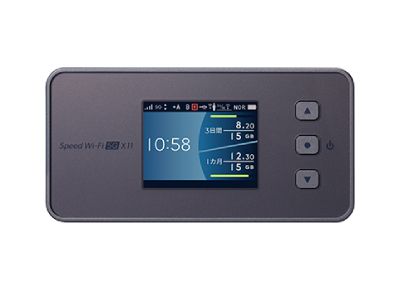
| Urban, upload-heavy work | A 5G-capable device — WiMAX+5G |
| Regional or mountainous areas | A 4G LTE plan; 5G coverage thins out quickly outside cities |
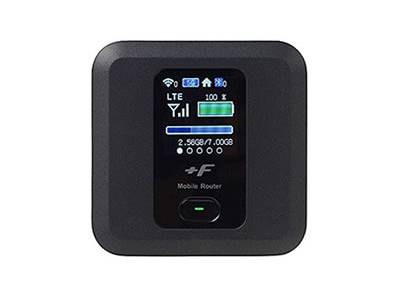
| Carrying the device daily between home and campus | The lighter device — SoftBank's FS030W at 128 g |
Providers to check for yourself. Names in this market, so you can verify the categories above directly: in tourist daily rental, Ninja WiFi, Global WiFi, Japan Wireless and Pupuru; in flat-rate monthly, Sakura Mobile and Mobal; in tiered monthly, CDJapan Rental. We've deliberately not reproduced anyone's prices here, because they change — check current figures on each company's own site before deciding.
| Plan | 3 months | 6 months | 12 months |
|---|---|---|---|
| WiMAX+5G Unlimited | ¥6,600 / month | ¥6,000 / month | ¥5,500 / month |
| SoftBank Unlimited | ¥6,600 / month | ¥6,000 / month | ¥5,500 / month |
| SoftBank 100GB | ¥5,900 / month | ¥5,300 / month | ¥4,600 / month |
Reference: CDJapan Rental published monthly rates. The two unlimited plans are identically priced at every term length and differ only in hardware and network. Check the WiMAX+5G, SoftBank Unlimited and SoftBank 100GB product pages for current rates and the first-month discount.
| Charge | Amount | When it applies |
|---|---|---|
| Early termination | About one month's rent | Cancelling inside the minimum contract term |
| Late return | ¥1,200 per day | Device not received after your contract ends |
| Loss or damage | ¥24,000 per device | Also applied if the device isn't received within 5 days of contract end |
It depends entirely on how long you're staying, which is why a single answer doesn't exist. Flat-rate providers with no minimum term tend to win at around three months; tiered providers win at six months and clearly win at twelve, because their rates fall with committed length. Below about 60 days, neither wins — a daily rental costs less than any monthly plan.
No, and this is the most important thing to check. Some unlimited plans are genuinely uncapped with no monthly ceiling. Others are large monthly allowances that throttle once you pass the limit, and daily-allowance plans throttle after a set amount each day. Ask what the ceiling is, what the speed is afterwards, and when it resets.
Not for a rental provider. Rental pocket WiFi companies serving foreigners generally have no residence card requirement and accept foreign-issued cards, unlike Japanese domestic carriers, which typically require a residence card with about three years of validity remaining plus a Japanese account. Confirm the specific provider's payment requirements before ordering, since they vary.
Only if you're mostly in urban areas and doing upload-heavy work such as video calls, cloud sync or content uploads. Japan's 5G coverage is concentrated in cities, and 4G LTE is more than adequate for streaming, navigation and general use. Most rental devices in this market are 4G LTE only.
Activation or setup fees, optional insurance, delivery charges, and the cancellation procedure. Run at least one provider through to the final confirmation step before comparing totals — headline monthly fees in this market are close enough that checkout additions frequently decide the outcome.
Yes, but factor in the gap. You'll need to return the first device and wait for the second to arrive, which means time offline, plus any early-termination fee if you're inside a minimum term. It's usually cheaper to choose correctly at the start than to correct mid-stay.
Staying six months or longer?
That's where tiered pricing earns its keep. CDJapan Rental's monthly pocket WiFi needs no residence card, no Japanese bank account and no two-year lock-in, accepts foreign-issued cards, and ships to airport post offices, hotels and Airbnb addresses so you're online the day you land.
View WiMAX+5G plans View SoftBank plans Short-term daily rental
For use over 90 days (Monthly Plan)